
You sign off numbers that someone else calculated.
Your AI answers fluently. You are liable.
The whitepaper “The Context Layer for regulated organisations” shows how every AI answer becomes explainable – down to the document you put your name on. Built from what your house already owns.
PDF, free, no sales call attached.
“AI has a context problem, not an intelligence problem.”
The distrust premium: the tax nobody budgets
The business unit recalculates what controlling already calculated, because proof that the number is correct is not delivered automatically. The meeting starts with whose number counts. The document waits until one more person has looked at it.
This is not a calculation error. This is a context problem.
Calculated twice
The same KPI means something different per system. So everyone recalculates – in hours no cost centre shows.
The whose-number meeting
The first half hour belongs not to the decision, but to which of the three numbers is right.
The fluent answer
With AI, numbers arrive faster and sound more certain. They are not clarified – and systems will not be liable.
The upgrade reflex
The real enemy is the reflex to answer wrong answers with the next, larger model. It spends money on intelligence where context is missing, and leaves the real question open: How should the AI know how your house calculates? That is why you do not need a new platform, but the Context Layer: the layer that gives the AI, with every answer, how terms relate, how the number is calculated and who may see it.
Similarity is not checking. And frequency is not correctness.
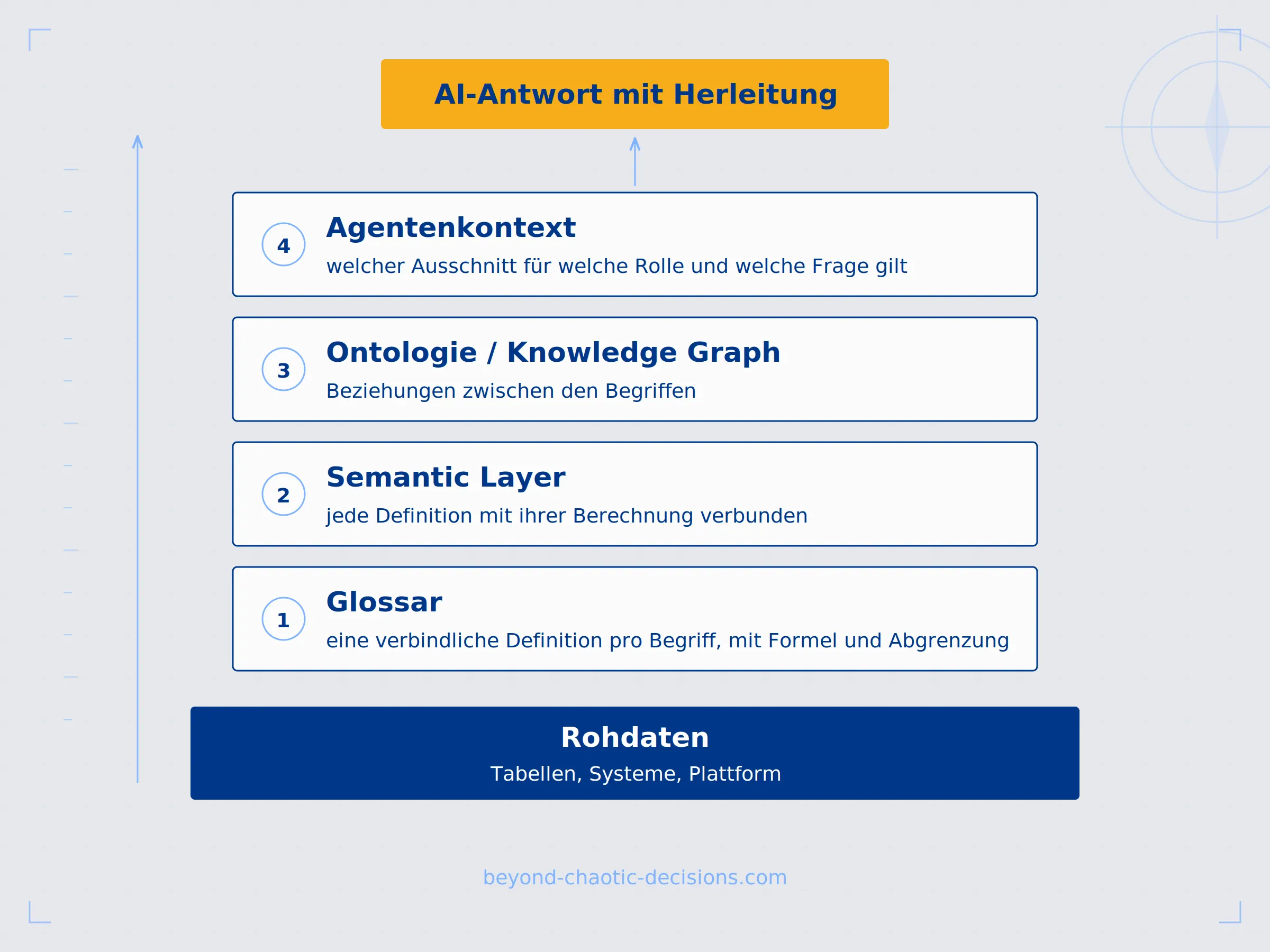
The Context Layer: four layers, no rebuild
Most houses do not fail on the model. They fail because nobody gives the AI context – on every single answer. Four layers stacked on each other deliver that:
Glossary
KPIs and dimensions defined bindingly; for KPIs with formula and owner. Not the most frequent meaning applies – the agreed one does.
Semantic Layer
Each KPI calculated once per dimension; everyone reads from the same source. Every number has a derivation.
Map of relationships
Two customers can be one household; an account is often a portfolio. Without relationships, you count wrong.
Context Layer
The layer your AI must query before every answer. Result: follow-up questions on ambiguity, refusal without entitlement, derivation for every number.
Measured, not claimed
- 478 automated backend tests and 24 frontend tests passed (working demo, as of 15.07.2026)
- 18 live check questions; for each the correct reaction is predefined, including follow-up and refusal
- 4 of 6 answer types deliberately deliver no number: definition, follow-up, justified refusal, honest not-found
- Experience anchor: 124 projects in regulated and data-intensive companies
Screenshots to follow: left answer with derivation, right justified refusal.
Demo-Screenshot 2 folgt.
You may think: another tool pitch. The whitepaper is product-neutral; the reference implementation is marked as one variant among several.
The whitepaper: The Context Layer for regulated organisations
PDF, free, 12 chapters plus glossary. Written for the person who signs documents – not for the implementation team.
- The four layers with a build planYou know what is built in which order
- Reference implementation, product-neutrally framedtransferable to your stack
- The self-test with three questionsusable tomorrow morning, without a project
- The graph in two expansion stagesstart small without sacrificing quality
- Glossary of all domain termsevery abbreviation explained
Afterwards you answer the question before signing: Does the same question next week yield the same number – and who can explain the derivation?
The contract is small
You give an email address, you receive a document. No follow-up meeting, no call list, no sales process in the background. If the whitepaper brings you nothing: two clicks, unsubscribed. What you keep is the self-test.
Three honest objections
Good – then you own the first layer. The whitepaper shows why a glossary alone enforces nothing and how it becomes the layer your AI must query on every answer. Start with the Semantic Layer chapter.
No. The architecture is described product-neutrally; Databricks and AWS appear as a marked reference implementation, one variant among several. Download the whitepaper and check chapter 10 yourself.
Examples come from finance; the mechanics apply to every regulated, data-intensive house: everywhere the same KPI means something else per system. The self-test works industry-independently – tomorrow morning.
The distrust premium keeps running until someone makes context binding.
No deadline, no countdown. Just the bill: every month without a Context Layer is a month of recalculating, whose-number meetings and fluent answers without derivation.
The platform is raw material. The decision is the difference.